Alright, friends, it’s time to lean in. We’ve all seen the “Winter is Coming” memes, but the meteorologists are trading in their usual “maybe it’ll snow” shrugs for some seriously high-confidence warnings. We are looking at a continental-scale monster.
We’re talking about a snow and ice shield stretching roughly 2,000 miles, impacting upwards of 160 million people. This isn’t just a “stay home and drink cocoa” kind of Saturday; this is a potential multi-day grid-failure event. If you’re in the path, it’s time to move from “thinking about it” to “doing it.”
Here is a good overview to prepare you:
— Ryan Hall, Y’all (@ryanhallyall) January 20, 2026
1. The Threat Profile: Know Your Enemy
Don’t let the “Southern” track fool you into thinking this is just a little slush. This storm is a two-headed beast with distinct “kill zones” for your daily routine.
- The Heavy Snow Corridor (OK, AR, TN, KY, VA, MD): We’re looking at high snow-to-liquid ratios. Translation: This is that deep, fluffy, dry snow that looks beautiful on a postcard but drifts like crazy and turns highways into parking lots in minutes.
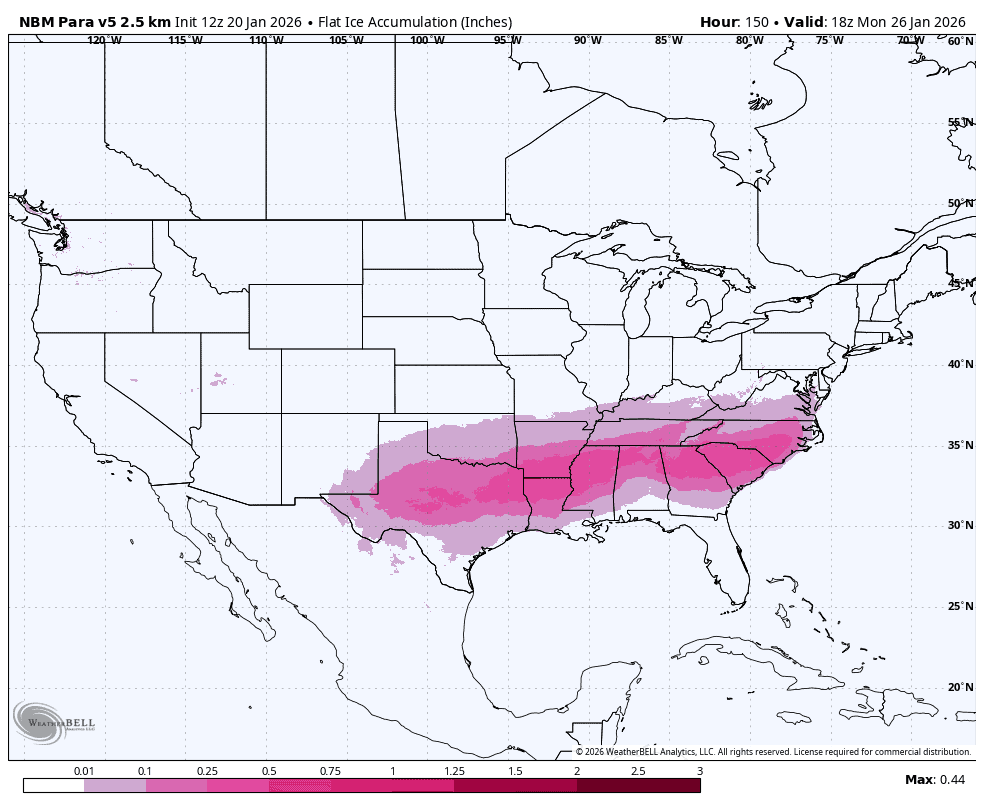
- The Ice Zone (Central TX through the Carolinas): This is the one that keeps preppers up at night. Even 0.25″ of ice accretion can turn power lines into snapping whips and tree limbs into heavy glass ornaments.
- Pro-Tip: When you’re scrolling through weather Twitter, ignore those “Total QPF” maps that look like a rainbow exploded. Those show total liquid. You want to look for “Ice Accretion” maps specifically. That’s where the real danger lies.
2. The “Grid-Down” Survival Protocol
If you find yourself in the Ice Zone, you need to operate under a simple assumption: The power will go out, and it’s staying out for 3 to 5 days. Here is how we handle that.
Water Security
When the grid blinks out, the water often follows—either because well pumps stop or city mains burst from the ground heaving.
- The Move: Sanitize your bathtubs right now and fill them up. If you have a WaterBob, get it in there. Aim for 1 gallon per person, per day, plus extra for the “luxury” of flushing the toilet and washing your face.
Thermal Layering & Room Containment
Heating a whole house with no power is a losing battle.
- The Move: Pick one “warm room” (ideally the one with the fewest windows) and make it your bunker. Use heavy blankets or plastic sheeting to seal off the doorways to the rest of the house.
- Survival Tip: It is infinitely easier to keep 200 square feet warm with body heat and candles than it is to heat 2,000 square feet of empty hallways.
Communication & Intel
In a major ice storm, cell towers get overloaded or lose their own backup power. Your smartphone might become a very expensive brick.
- The Move: Charge every power bank and portable station (shoutout to my EcoFlow and Jackery owners) now.
- The Secret Weapon: Dust off that NOAA Weather Radio. When the internet fails, that battery-backed radio will be your only link to NWS updates.
3. The Ice Storm “No-Go” Rules
Let’s be real for a second—some things just aren’t worth the risk.
- Stay Off the Roads: I don’t care if you have a lifted 4×4 with the best tires money can buy. You can’t drive on a sheet of glass, and you certainly can’t drive through the 18-wheeler that just jackknifed in front of you. Stay home.
- Generator Safety: This is the big one. Never run a generator in a garage, even with the door wide open. Carbon monoxide is a silent, odorless killer that claims more lives during these storms than the cold does. Keep it outside, period.
- Tree Hazards: If you have a massive oak limb hanging over your bedroom, maybe sleep on the couch in the living room tonight. When that ice builds up, those limbs don’t just bend—they shatter.
4. The 48-Hour Pre-Storm Checklist
You’ve got a window of opportunity. Use it.
- [ ] Fuel Up: Top off the cars, the chainsaws (for those downed limbs), and the generators.
- [ ] The “Clean Start”: Do every load of laundry and every dish in the house right now. You do not want to be stuck in a dark house with a sink full of dirty plates and no clean socks.
- [ ] External Prep: Disconnect your hoses and wrap those spigots. If you have light patio furniture, bring it in or tie it down; ice-coated chairs make for dangerous projectiles.
- [ ] Check Your Neighbors: Take five minutes to check on the elderly folks on your block. Ensure they have a plan and a heat source that doesn’t require a plug.
The Bottom Line
This isn’t a “wait and see” situation. The models have locked in, the moisture is there, and the arctic air is ready to party. Preparation is truly the only thing that turns a catastrophe into a cozy (albeit chilly) story to tell later.
Finalize your gear, charge your batteries, and stay safe out there.